
How to Create Product Descriptions with AI on Shopify

Writing compelling product descriptions is one of the most time-consuming yet crucial tasks for any Shopify store owner. With thousands of products to list and the constant pressure to optimize for both search engines and conversions, many entrepreneurs struggle to create descriptions that truly sell. Enter AI-powered product description generation – a game-changing solution that can transform your e-commerce workflow.
Why Product Descriptions Matter More Than Ever
Before diving into AI solutions, it's essential to understand why product descriptions are critical for your Shopify store's success. Well-crafted descriptions serve multiple purposes: they inform potential customers about product features and benefits, help search engines understand and rank your products, and ultimately convince visitors to make a purchase.
Research shows that 87% of buying decisions begin with research conducted online, with product pricing and packaging having a statistically significant relationship with the buyer decision process. Poor or generic descriptions can lead to high bounce rates, low conversion rates, and missed opportunities for organic search traffic. This is where AI can make a significant difference by helping you create unique, compelling, and SEO-optimized descriptions at scale.
Understanding AI-Powered Product Description Generation
AI product description generators use advanced natural language processing models to create human-like text based on product information you provide. These tools analyze product features, benefits, target audience, and brand voice to generate descriptions that resonate with your customers while maintaining consistency across your entire catalog.
The technology has evolved significantly in recent years, with modern AI tools capable of understanding context, tone, and even industry-specific terminology. They can adapt their writing style to match your brand voice, whether you're selling luxury fashion items that require elegant, sophisticated language or tech gadgets that need clear, feature-focused descriptions.
Top AI Tools for Shopify Product Descriptions
Built-in Shopify AI Features
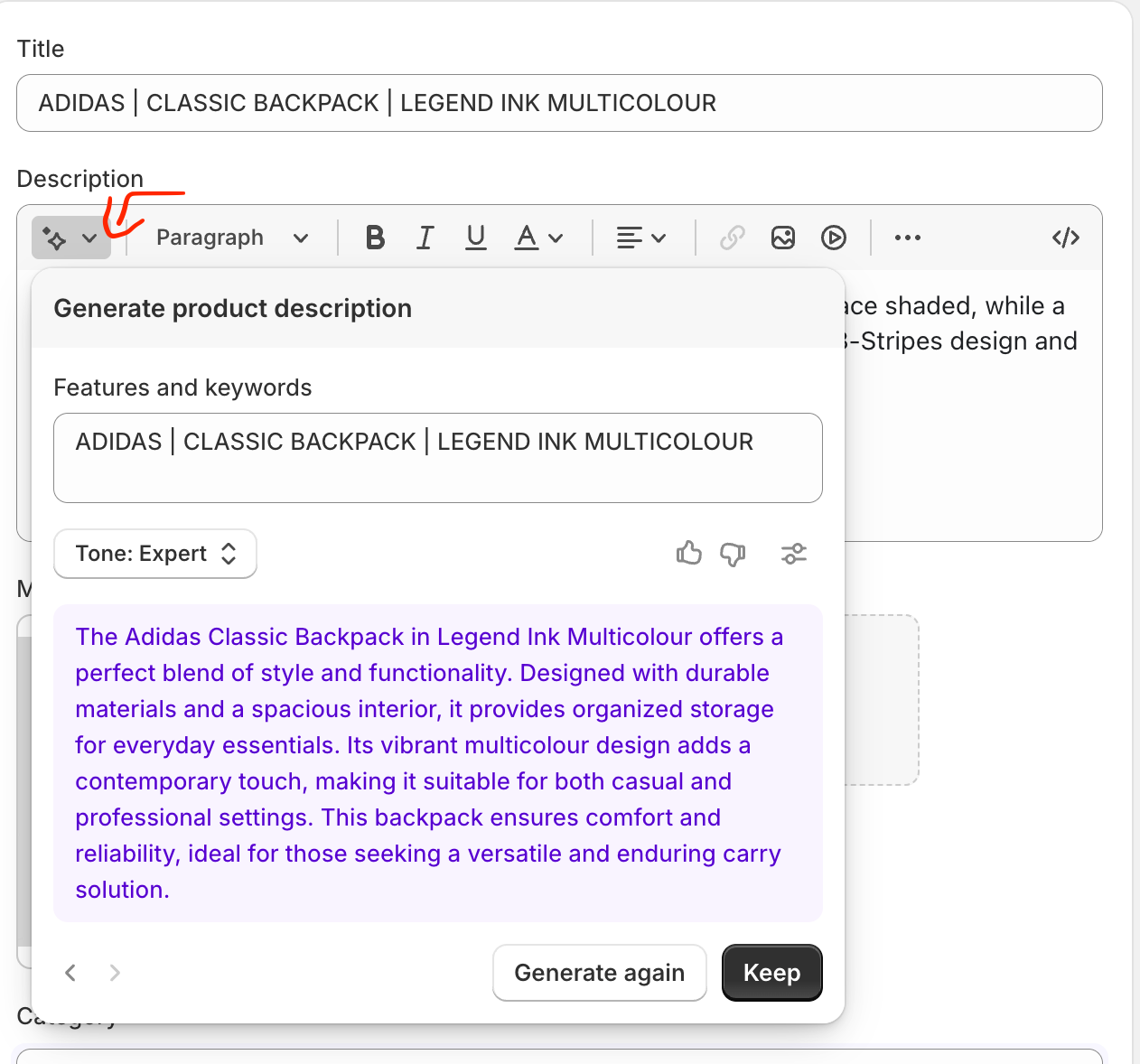
Shopify has integrated AI capabilities directly into its platform through Shopify Magic, their suite of AI-powered tools. The product description generator within Shopify Magic allows you to create descriptions by simply entering a few keywords or product details. The tool considers your brand voice and automatically generates SEO-friendly content.
To access this feature, navigate to your product page in the Shopify admin, click on the description field, and look for the "Generate with AI" option. This native integration makes it incredibly convenient for store owners who want to streamline their workflow without switching between multiple platforms.
AI models from ChatGPT, Claude and Gemini
AI models are powerful options for creating product descriptions. While not specifically designed for e-commerce, they excel at understanding context and generating human-like text. You can create detailed prompts that include product specifications, target audience information, and brand guidelines to generate customized descriptions.

The key to success with AI models chat interface lies in crafting effective prompts. Instead of simply asking for a product description, provide comprehensive context about your product, target market, desired tone, and specific features to highlight. This approach yields much better results than generic requests.
Step-by-Step Guide to Creating AI Product Descriptions
Step 1: Gather Product Information
Before using any AI tool, compile comprehensive information about your product. This includes basic specifications like dimensions, materials, colors, and functionality, as well as more nuanced details like the problems it solves, its unique selling propositions, and the emotions it should evoke in potential customers.
Create a product brief that includes the product name, key features and benefits, target audience demographics and psychographics, brand voice and tone guidelines, primary and secondary keywords for SEO, and any unique selling propositions or competitive advantages.
Step 2: Choose Your AI Tool
Select an AI tool based on your specific needs, budget, and technical comfort level. If you prefer staying within the Shopify ecosystem, start with Shopify Magic. For more advanced customization, consider tools like Jasper AI or ChatGPT.
Step 3: Craft Effective Prompts
The quality of your AI-generated descriptions depends heavily on the prompts you provide. Create detailed prompts that include all relevant product information, specify your desired tone and style, mention your target audience, include SEO keywords naturally, and specify the desired length and format.
Here's an example of an effective prompt: "Create a product description for a premium organic cotton yoga mat targeting health-conscious women aged 25-45. The mat is 6mm thick, eco-friendly, non-slip, and comes in three earth-tone colors. Emphasize sustainability, comfort, and performance. Write in a warm, encouraging tone that speaks to the customer's wellness journey. Include keywords like 'organic yoga mat,' 'non-slip,' and 'eco-friendly.' Keep it under 200 words."
Step 4: Generate Multiple Variations
Don't settle for the first description generated. Create several variations and compare them for effectiveness. Different AI tools may produce varying results for the same prompt, so consider testing multiple platforms to find the best output for your needs.
Step 5: Edit and Optimize
AI-generated content should serve as a starting point, not the final product. Review each description for accuracy, ensure it aligns with your brand voice, verify that product specifications are correct, and optimize for SEO by naturally incorporating relevant keywords.
SEO Optimization for AI-Generated Descriptions
Creating SEO-friendly product descriptions requires strategic keyword integration without sacrificing readability or user experience. Start with thorough keyword research to identify primary and secondary keywords relevant to your products. Tools like Google Keyword Planner, Ahrefs, or SEMrush can help identify high-volume, low-competition keywords.
When incorporating keywords into AI-generated descriptions, focus on natural integration rather than keyword stuffing. Modern search engines prioritize user experience and can detect and penalize content that appears artificial or over-optimized. Include your primary keyword in the first 160 characters, use secondary keywords throughout the description naturally, incorporate long-tail keywords that match customer search intent, and include semantic keywords and related terms.
Structure your descriptions with clear hierarchy using header tags when possible within Shopify's product description field. While traditional H1, H2 tags might not be applicable in product descriptions, you can use formatting like bold text and bullet points to create visual hierarchy and improve readability.
Best Practices for AI Product Descriptions
Maintain Brand Consistency
Develop clear brand voice guidelines before generating descriptions. This includes preferred tone (professional, casual, playful), industry terminology preferences, words or phrases to avoid, and style guidelines for formatting and structure. Share these guidelines in your AI prompts to ensure consistency across all generated content.
Focus on Benefits, Not Just Features
While AI tools are excellent at listing product features, ensure your descriptions emphasize benefits and emotional appeals. Instead of just stating "waterproof material," explain how this feature benefits the customer: "stay dry and comfortable during unexpected weather changes."
Use Social Proof and Trust Signals
Incorporate elements that build trust and credibility into your descriptions. This might include mentioning certifications, awards, customer testimonials, or satisfaction guarantees. While AI might not automatically include these elements, you can specify them in your prompts or add them during the editing phase.
Optimize for Mobile Readability
With over 60% of global e-commerce sales made via mobile devices as of 2023, ensure your AI-generated descriptions are mobile-friendly. This means using shorter paragraphs, bullet points for easy scanning, and clear, concise language that's easy to read on smaller screens.
Include Relevant Technical Specifications
For products where specifications matter (electronics, appliances, clothing), ensure your AI descriptions include relevant technical details. Create prompts that specifically request inclusion of size charts, compatibility information, care instructions, or warranty details as appropriate for your product category.
Advanced Techniques and Automation
Bulk Description Generation
For stores with large inventories, consider developing systems for bulk description generation. This might involve creating CSV templates with product information that can be processed through AI tools programmatically. Some advanced users integrate AI APIs directly into their product management workflows.
Dynamic Description Updates
Implement systems that can update descriptions based on changing factors like seasonality, inventory levels, or promotional periods. This might involve using Shopify's API in combination with AI tools to automatically refresh descriptions for featured products or seasonal items.
Integration with Inventory Management
Connect your AI description generation process with inventory management systems to automatically create descriptions for new products as they're added to your catalog. This ensures consistency and reduces manual work as your product range expands.
Common Pitfalls and How to Avoid Them
Over-Reliance on AI Without Human Review
Never publish AI-generated content without human review. Common issues include factual errors, inappropriate tone for certain products, missing important product details, and repetitive language across similar products. Always have a human editor review and refine AI output.
Ignoring Brand Voice
AI tools can sometimes produce generic content that doesn't reflect your brand's unique personality. Combat this by developing detailed brand voice guidelines and including them in every AI prompt. Regularly audit your descriptions to ensure they maintain consistency with your brand identity.
Keyword Stuffing
While AI tools are generally good at natural language generation, they can sometimes over-optimize for keywords when specifically instructed to do so. Focus on creating valuable, readable content first, with SEO as a secondary consideration.
Not Testing and Iterating
The most successful implementations involve continuous testing and refinement. Regularly A/B test different description styles, monitor performance metrics, and adjust your AI prompts based on what works best for your specific audience and products.
Future of AI in E-commerce Content Creation
The landscape of AI-powered content creation is rapidly evolving. Emerging trends include more sophisticated personalization capabilities, integration with visual AI for image-based description generation, real-time optimization based on user behavior, and improved understanding of industry-specific terminology and requirements.
Voice search optimization is becoming increasingly important, with AI tools beginning to optimize content for conversational queries. Visual AI integration allows for automatic description generation based on product images, while advanced personalization creates different descriptions for different customer segments.
Conclusion
AI-powered product description generation represents a significant opportunity for Shopify store owners to improve efficiency, consistency, and sales performance. By understanding the available tools, implementing best practices, and maintaining a focus on quality and user experience, you can leverage AI to create compelling product descriptions that drive conversions and improve search rankings.
The key to success lies in viewing AI as a powerful assistant rather than a replacement for human creativity and oversight. When used strategically, AI can free up valuable time to focus on other aspects of your business while ensuring your product descriptions remain fresh, engaging, and effective.
Start with small tests, measure your results, and gradually expand your AI implementation as you become more comfortable with the tools and processes. With the right approach, AI-generated product descriptions can become a competitive advantage that helps your Shopify store stand out in an increasingly crowded marketplace.
Remember that the goal isn't just to create descriptions faster, but to create better descriptions that serve your customers and drive business growth. By combining the efficiency of AI with human insight and creativity, you can achieve both objectives and build a more successful e-commerce business.
References and Sources
CXL Institute. (2025). "How To Influence Purchase Decisions: 9 Factors Affecting the Consumer Decision Process." CXL Blog. Available at: https://cxl.com/blog/9-things-to-know-about-influencing-purchasing-decisions/
Frontiers in Psychology. (2021). "Impact of Pricing and Product Information on Consumer Buying Behavior With Customer Satisfaction in a Mediating Role." Frontiers in Psychology, 12:720151. DOI: 10.3389/fpsyg.2021.720151
Zhang, L., et al. (2022). "The Impact of Online Reviews on Consumers' Purchasing Decisions: Evidence From an Eye-Tracking Study." Frontiers in Psychology, 13:865702. DOI: 10.3389/fpsyg.2022.865702
Research Gate. (2024). "Analyzing the Influence of Product Descriptions, Ratings, and Reviews on Online Consumer Purchasing Decisions." International Journal of Research, March 2024.
Statista. (2023). "Mobile Commerce Statistics - Global E-commerce Sales Distribution." E-commerce Market Data.
Gauss Digital. (2024). "Mobile E-Commerce - Latest Statistics for 2024." Gauss Analytics Report.
DesignRush. (2025). "Ecommerce Statistics 2025: Growth, Trends & Business Intelligence." DesignRush Industry Report.
PwC. (2023). "Global Consumer Insights Pulse Survey June 2023." PwC Consumer Markets.
SellersCommerce. (2025). "51 ECommerce Statistics In 2025 (Global And U.S. Data)." SellersCommerce Research.
Backlinko. (2025). "36 Up-To-Date Ecommerce Statistics for 2025." Backlinko Research.
Note: Statistics and research data cited in this article are based on the most recent available studies from industry reports, academic journals, and market research firms. E-commerce trends and consumer behavior patterns continue to evolve rapidly, and readers should consult the latest industry reports for the most current data.